
“It seems to me that the work in hand is to make of the world a great book, to be written in gold on vellum.” —Welvan
This page is an encyclopædic reckoning of the known lands of Armenground, comprising the lands north of the Living Venom and the isles that lie thereabout, as they were circa the Year of Greater Starlight, the seven thousand three hundred and eighth Dawn-year.
Armenground is a world-setting made with Dungeons & Dragons in mind. Its first campaign, Where Snarls the Darkness, began in a prototype version of the world in February 2024. The following is an index of general knowledge; campaign specific information, including player and non-player characters, will be exclusive to the campaign pages themselves.
ARKENWEN. Deity The god of galder. Though originally aligned with the Twelve, in time he began to resent their use of mortal Men as pawns in the cosmic struggle. In what he held to be an act of equalizing justice, he bestowed the use of galder—spendable divinity drawn immediately from Owil, an art that only he mastered—upon a certain few of the first mortals, chiefly Morwendel. Since that time he has maintained the mystery of galder in Armenground and is the patron of wysards. The exercise of his divine bounty by skilled mortals in the service of other gods has won him some favor again among the Twelve; yet the very nature of his gift is uncertain to most. Whether a bolt of lightning-galder is derived from Arkenwen or from Gluthrim, for example, is much disputed. Welvan, in his chronicle, claims that it is of both, Gluthrim being the willing message, Arkenwen the willing messenger, and the caster the willing mark and place of arrival.
“O helpless beings: go ye forth and withspurn evil in greater might!” —Arkenwen in Hudvorenn, a high-elven epic
BILVENDOL. Deity The god of prophecy. A blind god-child barely capable of comprehending the contemplations of his origin, Hallowil, he relays Hallowil’s suppositions for the future to mortal ears. He never takes a full form, so absorbed and drawn by the machinations of his parent-mind; his votaries are known to blind themselves or otherwise deprive themselves of sensation so that they, too, might devote a greater part of their perception to comprehending the predictive power of Bilvendol and, in turn, Hallowil.
THE BLADE of UNSHACKLED LIGHT. Item Also the Prismatic Blade. The iridescent longsword of Bleewen. Bleeding light itself, it is a terrible weapon relucantly crafted of dwarrowsteel by Cland and infused with the divine power of Bleewen’s radiance. When the treachery of Stornelwen against Velwen was discovered by Bleewen, the light-gidden used it to cleave her son into three disparate spirits with two strokes of the Blade.
“And so it was written that the splendid gidden Bleewen, the Radiant Lady, beseeched the smith-god Cland for a weapon worthy of her divine light. …” —The theological prologue of the Chronicle of Welvan
BLEE-AMBER. Material A bright resin, found rarely but roughly evenly in the soils of Armenground. It is popularly said to be splinters of Stornelwen, fallen earthward after his slaughter; it shines silver-gold beneath the light. It is much coveted for this, and ambitious painters grind it into pigment. Some tattoo it upon the body.
BLEEWEN. Deity The gidden of light and color. Illumination in all its forms was the invention of Bleewen, who sought a new dimension to perception and experience beyond mere feeling and hearing. In her luminous mission, she shaped Velwen, the Golden Sun, and Stornelwen, the Silver Sun. She clove Stornelwen in three for his envy of his sister not long after the First Dawn; this slaying was the first godslaught. Her absolute intolerance for injustice and her brilliant radiance has earned her numerous devotees, many of whom carry dispersive prisms, the rainbows of which are thought to represent the full spectrum of Bleewen’s creative faculties.
BLONDORIM. Deity The god of mountains and stone. The great shelterer and stone-bulwark, Blondorim’s answer to the misdeeds of the God-Foes is unrelenting mountainous resilience. It was he who first tasted the cold of the high climes, and his daughter, Tirawen, was made to spread the gift and pain of the cold to all the peoples of the world as winter.
BONE KNIGHT. Creature Also oathbreaker. The deathless corpse of a godsknight that broke their holy oath. Usually rising long after the original death—a disturbing spectacle foreshadowed by years of a corpse’s restlessness and unnatural movement—bone knights are easily manipulated by the forces of chaos into vengeful struggle against the living. Theories on the nature of bone knights are various. Questions usually center around whether the soul of the original godsknight is still present within the bone knight—and if so, how it escaped Grimmil—or if it has simply been reanimated by some foul galder. Bone knights are, however, rare; restless corpses are often burned or broken, lest they rise. However, for those oathbroken godsknights buried beneath the earth or lying otherwise far away from living eyes, their transformation proceeds, producing a creature of age and stiffness but formidable martial power.
CAULRIM. Deity The god of all waters fresh and salt-laden. With eyes seeming themselves painted as the sea, he guides sailors to safety and calms the tempests of Olsevor. He committed the task of protecting beaches unto his son Sholnim. Fond of living beings but especially appreciative of their recognition, Caulrim is often paid Caulrim’s tax: some wary seafarers “pay” for safe passage, casting a small part of their goods into the deep. The commonest fashion of his image is as of an elder man, blue-eyed and sandy-haired, contrasting with the merry and more presumptuous countenance of Sholnim.
CLAND. Deity The god of craft and cunning handiwork. A reclusive deity, his chosen form has been deafened by millennia of forge-work. He no longer speaks, but smiths blades, tools and works beyond mortal imagination. He crafted the dwarrows—themselves hardy as metal—and both respected and built upon their work. He forged with dwarrowsteel the Blade of Unshackled Light, wherewith Bleewen slew Stornelwen, yet the guilt he took from the slaying led him to stop working with the metal. His beneficiaries are largely dwarves and craftsmen, the former of whom had been the sole recipients of dwarrowsteel works. Those appealing to Cland for favor are known to inscribe their tools and weapons with runes of praise to him. Cland, thou smithest strength has been carved into innumerable blades. His odd monosyllabic name may have originally been simply an imitation of hammer-strokes by Men who wished to name the nonetheless unspeaking god.
CLENWEL. Deity The gidden of civil order and daughter of Hallowil, the thought-god. Tethered to the concept of natural order in the face of chaos, she is an ardent defender of structure and organization. She is the matron of law-godswysards. Public debates and functions are usually consecrated in her name, feeding her need for order. Her likeness is a frequent sight in places of judgement and law—courts are often overlooked by statues of Clenwel, and her name is commonly evoked during executions. Temples dedicated to Clenwel are fortresses of sandstone and marble, exuding the ideal symmetry she esteems. Within their sanctuaries, fluted pillars emit soft sounds that law-clergy claim are frequencies to balance will itself.
“Just as stars must navigate in patterns strict and peculiar, so too must the lives and deeds of Man.” —Anonymous
COATHWIL. Maldeity The gidden of poison, venom, and disease, daughter of Paithar, god of ruin. Wreathed in poisonous flowers, she juxtaposes beauty and death in her spread of venomous suffering throughout Armenground. In nature, death rarely comes bearing hideous colors; the most poisonous creatures are simultaneously beautifully splendid and with mesmerizing patterns. Coathwil is the architect of that deceptive chaos. For this reason she has also been called the Splendid Poison.
CROWMAN. Race One of the crowmen, who call themselves Krákurnar. They are a feathered, bird-like race that dwells upon a lone, craggy isle off Armenground’s north-western coast. The grassy slopes of their island home are bare of trees, and so they seem to revere the properties of wood as giving life and fire. They were created in primordial divinity by a single conversation between Gelthiwil and Gluthrim.
DEATH BLOSSOM. Plant A small, pale blue flower that grows around the death-places of mortals who perish on soil. Followers of Gelthiwil, Grimmil and Selvenna claim it to be the influence of their respective gods. The flowers persist for various durations beyond a death, remaining at the same place even when the body is moved elsewhere. Some can last for years or decades, turning former battlefields into seas of pale blue. Some scholars have collected and pressed the death blossoms of famous heroes for preservation. Theological interpretations vary, but a common kenning used to represent death blossoms is god-tears.
DRAKE. Creature Drakes are intelligent serpentine beasts of Armenground, generally malevolent. Primeval creatures of chaos, they possess a staggering range of violent abilities—fire-breathing, venom and adroit flight number among their assets. After fearsome, destructive wars with early mortals, drakes largely vanished from Armenground. Their seaborne cousins, sea serpents, exist in greater number; enormous distant cousins known as sky serpents are the rarest in the family.
DWARROW. Race Also dwarf. Any of the dwarrows, one of the intelligent races of Armenground, who speak Dwarrish. They were wrought by Cland, and, for their fondness of ore and treasure, condemned to a small stature. They dwell chiefly in the deep places, shaped by Blondorim, and commonly live to two hundred years. The first of their kings were the twin-lords Viling and Saardo: both hard of will and slow to change, yet Saardo, by grace and speech, won the hearts of his folk. Viling, subtler of wit but little loved, forged from the wealth and crushing deeps of the mountains the fiery, rainbow-hued “dwarrowsteel”; yet still he stood in his brother’s shade. In a storm of envious wrath, Men say, he brought the first dwarrow-halls down upon them both, shutting king and king within the hills to brawl in darkness evermore, and leaving but a scant hoard of dwarrowsteel in all Armenground. Thus dwarrowkind, bereft of princes, grew rich in sorrow and in tale. Dwarrowsteel scarce rusts, and its flame-like sheen catches firelight with genuine brilliance; so have the dwarrows come to worship, almost with despair, a treasure born of their first calamity. After Viling and Saardo’s fall, their people broke by degrees into clans, each bound by craft, custom, and lineage, their names declaring what house held mastery in what art. Of this long sunderance our clearest witness is Orvo, the runed historian of the dwarrows.
DWARROWSTEEL. Material Also athlore. A highly coveted, extemely durable bright iridescent metal renowned for its excellent performance in armor and weaponry. First forged by the early dwarven king Viling and later by his apprentices, the art of creating the metal was lost after Viling collapsed the first dwarven halls to imprison himself and Saardo. Thought to be an alloy of an uncertain make—or, perhaps, an ore unique to the oppressive deeps of the dwarrows’ mountains—it has never been recreated, and only a limited hoard exists throughout Armenground.
Cland, god of craftsmen, acquired a store of dwarrowsteel by friendship with Viling, yet spent it sparingly, for reverence of its worth and rareness. The Twelve have taken little interest in unriddling the ingenuous work of the ancient dwarves, skeptical of mounting such an effort at the risk of its misuse magnifying bloodshed and viewing the present mortal weapons against evil as adequate. Cland himself forswore the metal after Bleewen slew Stornelwen therewith. Dwarrowsteel is distinguished from true steel by its watery, deathless gloss, and by a bell-like resonance whenever it is struck.
EHMÁRÁVINKUDA. Geography Ehmara’s-bight. A little fishing village set in an inlet south of Waternake along the Hursten Shore. Nestled in a quaint cove, it lies undercover, veiled from initial view compared to its busier trade-ripe neighboring port-town.
ELF. Race Any of the elves, one of the mortal kindreds of Armenground, who call themselves the oziganed. Created by Hallowil directly and shaped in thought and culture by Halwen, they stood among the four races of the world at the First Dawn. Chiefly they dwell in those places which they call Bro-Uhel and which are named the Elvenlands by outsiders. For patience and shrewdness, the gods permitted them to taste the deathless grace of divinity, and at Rosglañviz they raised a mighty city of limestone. Their humility has long cultivated an interest in the story of Stornelwen, named Arcanta, and Velwen, named Auora and a subsequent reverence for Stendew (Loarenn), Stornawil (Steredenna), and Strangil (Isfontenn). They are less likely to worship turbulent gods such as Gluthrim, though this is not unheard of. Because of their slowness to fight the chaos of the God-Foes, they were confined to small populations that reproduce slowly and painfully. Soon after the First Dawn, one branch departed from the elder stock, becoming the tree-elves of Gwenzon, apart from the high elves of Rosglañviz. Other populations have arisen since, among them the ice-elves and the deep-elves.
ELVISH. Language The language of the elves, which they call oziganec. Though Elvish is much prized for beauty’s sake, it is neither apter nor truer than the tongues of Men or other kindreds.
ENT. Race One of a race of trees endued with intelligence, quickened by Tosnawil with the Staff of Deathless Green. As the fruit of Tosnawil’s creative fantasies, they were condemned to help her efforts. The eldest of their kind—Aldac, “old oak”; Aldbec, “old beech”; and Aldfurh, “old pine”—abide in the Elder Grove. To them are committed both the Staff and the raising of new Ents. Their speech is Entish.
ENTISH. Language A tongue ordained for the ents by Halwen at Tosnawil’s own beseeching and appearing to be a slower, complex relative of Mathel. It is natively called entisc, of similar pronunciation to the word in Mathel.
FELDENNA. Deity The gidden of health. Though lively and cordial at heart, she is prone to long periods of rest, devoting her strength to the help of mortals. As the defender of wellness, she is perpetually opposed by Coathwil, gidden of disease and daughter of Paithar. She is often characterized as a sleeping older woman, hands at rest on the sick and injured, and is hence commonly invoked by physicians and their institutions for aid in healing. Certain medicinal herbs, when burned, are thought to call upon her presence. Her children include death-god Grimmil, rest-gidden Stiliwin, and breath-god Solm.
FELSEVA. Maldeity The gidden of savageness, daughter of the fury-god Olsevor. She finds a perverse beauty in chaotic natural struggle—the rule of the strongest. She is relentlessly hunted by Felwilven, who she views as shackling the wild world. To wreak havoc on the natural order, she wields the Talons of Primordial Chaos—a pair of gauntlets infused with concentrated chaotic energy.
FELWILVEN. Deity The gidden of the hunt, daughter of Hardol, the war-god. She views killing as an act of primal beauty, of the return of divinity to the universe by way of death-god Grimmil, with whom she shares a close bond. Her iconic weapon is a spear of walnut, headed with an iron point, wherewith she ceaselessly pursues Felseva and all her works. Reverence of her varies by nation, but in many, at the first opening of the hunting season a solemn first chase is held, of whose yield a part is burnt in offering to some token or sign of her.
THE FIRST DAWN. History A story of the beginning of the world, recorded with some variations by the four great races and held as an ancient truth. It tells how Men, elves, dwarrows, and ents—the elder races—were summoned to the crown of the Galderbarrow to stand in judgement before the Twelve, while both suns hung in heaven together, a sight not seen ever again. For pride, Men doomed to brief and brittle lives; elves, for backwardness in war, to scant and slowly gotten numbers; dwarrows, for love of earthly treasure, to lowlier stature; and ents to serve Tosnawil, their headlong maker, in the keeping of the world. This tale has so deeply struck root in the learning of Armenground that Men reckon the years by the winters passed since that first morn.
THE FRORN BELT. Geography A frozen, jagged chain of mountains in Armenground’s north-west. Men often call it the Dwarrowlands, for dwarrows dwell in the greatest number there, and Blondorim holds it dear. In the eastern marches abide the deep elves. Within the mountains lie many strange and elder things, including many creatures of the foulest chaos of the world’s first age. So deadly are their passes that even such peoples as can live there dwell but thinly, and with wary hearts.
GALDER. Galder Also dwimmer (of illusions), magick, shinelock (derogatory). Mutable, spendable concentration of the same divinity of which the gods and giddens are derived. The calling and guiding thereof was an art first made possible by Arkenwen, who framed a secret chamber within the brains of mortal Men that might later be unlocked by other sorcerers, or by divine occurrences, to move and order galder; he hoped thereby to afford mortals a greater mastery over their own destinies. Morwendel, the Lady of Magick, was the first and chief paragon of this power. One who is skilled and lettered in the use of galder is called a wytch or a wysard, and whatsoever is wrought by such art is said to be galdered. They who, either by birth or by gift of a god, are imbued with innate skill in the channelling of galder are named galderborn. When galder is fastened unto a weapon, it is often termed gale, and the act of laying such an enchantment upon it is to begale.
THE GALDERBARROW. Geography Armenground’s highest seat, set amid a knot of mountains in the far north-east. Its unique position gives it unusually long or short days and entire seasons of perpetual twilight. The continent generally slopes upward toward the mountain, which is focal point for much mythology. It was the site of the First Dawn and the judgement of the four first races: Men, elves, dwarves, and ents. The flora of the mountain itself consists largely of low grasses, shrubs and thistles. A heavy fog on the slopes of the mountain confounds mortal visitors, however. In its southwestern foothills lies the Elder Grove. Though much of Armenground's north is snowy and frigid, a general warmth seems to blanket the regions surrounding the Galderbarrow. Any who draw near must strive against a dream-like trance that would overtake them.
“Was there ever a greater sight in all eld?” —Wendelwen of the Galderbarrow, supposedly her final words
GALDERBORN. Playable Class One born with galder. Unlike wysards, who choose the art and win it by long study, the galderborn bear magick in their very blood, or are gain it by an act of divinity; thus their galder is innate, not earned by book nor practice.
GAWIL. Deity The god of shades, born to Bleewen after Stornelwen’s death. He is tasked with keeping watch over darkness, cleansing it of what evil he can find. Haunted by the burden, he leads an existence often fully separate from the other deities.
Stornelwen and Velwen had been intended to circle Armenground for all time as twin suns, bathing it in endless light; after Stornelwen was shattered, so too was hope of this goal. Bleewen had undone one of the greatest uses of her divinity, and in doing so had introduced constant shadow to the land. Gawil was the solution: a hunter to seek out evil lurking in shadow, doing endless battle upon it.
He holds steadfastly to his purpose, never outwardly expressing his inward turmoil at being created solely as a partial replacement for a dead son. Devotees to Gawil also cling to steadfast purposes; he is revered by night watchmen and occasionally by miners and other delvers into shadow. Gawil’s followers practice rituals in complete darkness to honor their god, believing that true understanding and vigilance come from the ability to navigate and guard the shadows.
GELTHIWIL. Deity The gidden of the glades and nature’s quiet peace. One of the Three Siblings—a trio of divinities who steward the earth—she weaves living beings together with the natural world in harmony and endears the natural world to living things. She is credited with tailoring much of the natural landscape of Armenground; her creation of birds was so admired by Gluthrim that the crowmen were born of a compliment he issued her. Her cautious craft stood in contrast to the more restless creation of her sister Tosnawil. Gelthiwil’s devotees believe that dancing, singing, and laying flower garlands in her meadows please Gelthiwil. The concept of “Green Feasts” is popular among her worshippers entailing a feast of entirely foraged meals; the leftovers are scattered in the glades as an offering. Individuals wishing for personal tranquility or happiness often spend solitary time in nature as an offering to their gidden.
“More brilliant than the sun is the shade of verdure; more faithful than lovers sits the earth beneath our feet.” —Anonymous
GHOUL. Creature What remains of a mortal who lived a life so vile and corrupt that what divinity existed within them withered away, leaving them incompatible with the afterlife. Their rotting corpses roam after their demise, seeking half-intelligently to do evil upon others until what vestiges of life drive them are expelled in combat. Vendra’s game is in whittling away at the virtues of mortals, seeking that they may become ghouls. Ghouls cannot rise from bodies killed by divine or holy means or from bodies obliterated during death.
GHOST. Creature A soul that has, for any number of reasons, slipped past the watch of Grimmil. Usually feeling that a purpose still remains for them in Armenground, they wander restlessly until their will is accomplished or they are captured by Grimmil. Their nature and effects on the material world are varied—their visibility and corporeality are dependent upon the circumstances of their appearance and the divinity at work. In the rare case that a ghost has been left in Armenground not of its defiant will but because of an exception by Grimmil, a shrine or reliquary is used to tether the soul to reality. They are distinct from ghouls in that they still retain some shred of divinity and exist outside of corporeality.
GIDDEN. Word Designation for a god who most often appears in feminine form, i.e. a goddess.
GLEEMAN. Playable Class Also bard. A bringer of music, poetry, and song. Talented gleeman have, in their most impassioned performances, communed with the very gods and acquired their graces, and a song or bardic recital at times becomes an outgrowth of galder; the gift of song has ever been sacred. Gleemen who soar in the mastery of their art are not few, but the great, galdersome ones are rare.
GLUSKMOSS. Plant A red, flowerless herb, found cleaving in matted tufts unto a few scattered pools of the tide along the Hursten Shore in small number. It is little searched or written of, partly for the rarity thereof. The drinking of a thinned extract of gluskmoss is known to work strange alterations upon the body of the user: veins and eyes exhibit a faint red shining, much like the plant’s own light, and a nearly dissociative state of heightened strength and bodily prowess is induced.
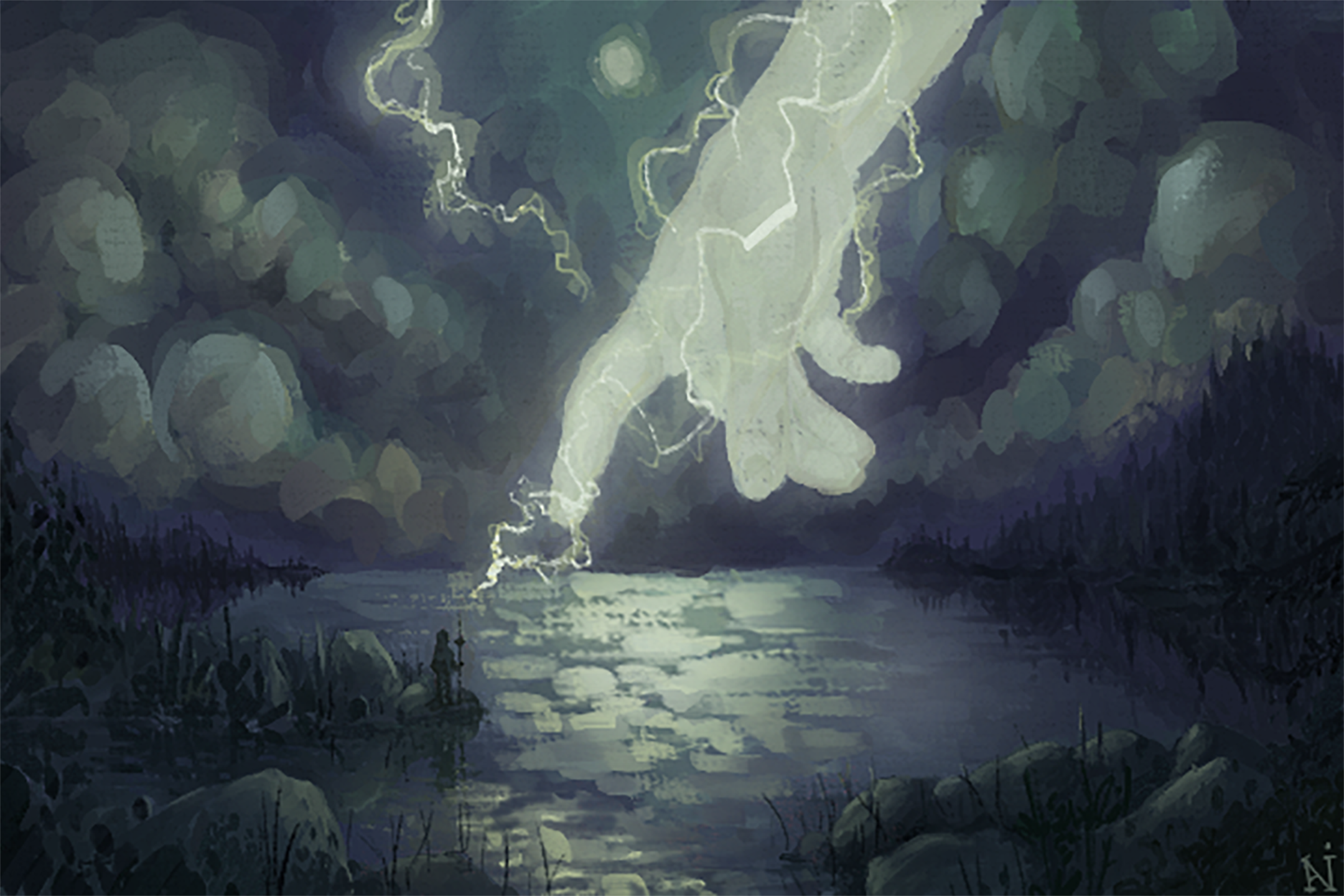 The reaching Gluthrim, by Nina, 2024.
GLUTHRIM. Deity The “Sacred-in-Wrath”, god of thunder and electricity. Wreathed in lightning—comparatively minor discharges of his divinity—his booming laughter comes to mortals as thunder. His spear of concentrated lightning is said to be among the mightiest weapons ever conceived. Though the most wrathful toward places of evil and chaos—Olsevor chiefest among them—Gluthrim’s temperamental nature and reckless storm-raising leads his storms to afflict most of Armenground nonetheless. Convinced of the usefulness of his wrath, he spun off his milder aspects as a daughter, rain-gidden Istwin, and spawned Men as his more turbulent interpretation of elves. He issued a word of compliment to Gelthiwil for her creation of birds; the crowmen were born of that conversation. Worshippers of Gluthrim meet storms reverently. He is often venerated with deafening drum ceremonies celebrating the god’s might and capacity for purification. Tall, isolated temples that attract lightning are places of greatest importance for Gluthrim’s worshippers.
The reaching Gluthrim, by Nina, 2024.
GLUTHRIM. Deity The “Sacred-in-Wrath”, god of thunder and electricity. Wreathed in lightning—comparatively minor discharges of his divinity—his booming laughter comes to mortals as thunder. His spear of concentrated lightning is said to be among the mightiest weapons ever conceived. Though the most wrathful toward places of evil and chaos—Olsevor chiefest among them—Gluthrim’s temperamental nature and reckless storm-raising leads his storms to afflict most of Armenground nonetheless. Convinced of the usefulness of his wrath, he spun off his milder aspects as a daughter, rain-gidden Istwin, and spawned Men as his more turbulent interpretation of elves. He issued a word of compliment to Gelthiwil for her creation of birds; the crowmen were born of that conversation. Worshippers of Gluthrim meet storms reverently. He is often venerated with deafening drum ceremonies celebrating the god’s might and capacity for purification. Tall, isolated temples that attract lightning are places of greatest importance for Gluthrim’s worshippers.
GOD. Word A term for any of the deifically powerful divinities whose deeds govern Armenground and its enveloping cosmos. They are the product of the shattering of the crystallized divinity that permeated the empty universe—a simultaneously roaring and still river of raw, celestial thought sundered into several roughly even parts at the will of a higher, incomprehensible entity in the depths of primeval time. Twelve of the god-shards tended toward the notion of harmonious existence and creation; three, led by Paithar, tended to destruction and mischief, and two, Arkenwen and Selthwen, roamed pathless. The Twelve, as the former are known, have reasoned that the purpose of their existence—owing to their natural instinct for harmony—is the purpose of keeping the forces of chaos at bay. The ultimate, unknown higher entity—termed Owil, the eternal intention—has thus been characterized as a great tester, silently watching the heights of heroism and depths of cruelty as spirits wage war for the sake of harmonious beauty.
Finding matter to be fitting vessels for this divine struggle, the gods cast their powers into shaping a mighty continent—Armenground, or great earth—through which the forces of good and evil could contest in mortal form. The tall, limbed, fleshy forms of the creatures they created were perfectly suited for terrestrial life. Each divinity took on individualized powers to enhance their role in the conflict, and often conduct their affairs in physical, forms that resemble the biological souls they created. While they exercise some limited influence over the mortal world and have created offspring which can do nearly the same, animating matter came at the cost of such divinity that much of the struggle against chaos now rests largely in the hands of earthly beings, into which the struggle has been channeled. Seeing a vision of a god is rare; seeing an avatar of them is a thing of myth.
The gods are so preoccupied with their celestial struggle and the strenuous effort to keep all in balance that there exists doubt in certain populations as to their existence. Though they have revealed themselves to mankind—occasionally directly, as in the case of Bilvendol—they do so with such rarity that those who have heard from the gods are treated somewhat seriously but are liable to be dismissed as insane among committed skeptics. Religion usually revolves around appealing to one or multiple gods depending on one's circumstances and personal inclinations, or to devoting one's inner divinity to the creation of harmony. To distinguish extant gods from past ones, the existing deities are sometimes called the Gods That Be.
“Long before the named stars had been set to twinkle in Armenground’s sky, the Twelve were caretakers of an infant cosmos still untamed and whirling with potential. Yet, past eons witnessed shadows dancing in the raw fires of creation. These were the God-Foes, ancient beings with forms undefined, elements of discord—divinities embodying destruction, pandemonium, and cruel, cold entropy leading to absolute ruin. To them, entropy is beauty, and they are but solar winds ushering splendid annihilation across the cosmic domains. The God-Foes reveled in their chaotic spirals, souring rivers that ought to have run sweet, withering blossoms aloft afore ordained springs, and strewing stars askance, forcing them to fail and fall prematurely from hidden heavens. Maelstroms clove lands asunder whilst sylvan sanctuaries languished.” —Second-millennium priest
GOD-FOE. Word One of the three shards of divinity that views entropy as beauty and hence accelerates destruction to manifest the flattening of the universe. They disregard life and creation and are held as evil by mortal minds.
GODSKNIGHT. Playable Class Circumstantially giddensknight. One of the callings of Armenground. Oathsworn to a deity, mortal, or principle, they are powerfully tethered to the subject of their devotion. A crownsworn godsknight, for example, would find betraying its liege to be an act not distant from death itself. The bodies of dead godsknights who failed to keep their oaths are known to be restless and disturbed. Even long after death, they are known to rise again as bone knights: undead warriors, easily manipulated by the forces of chaos, who will fight aimlessly until their complete obliteration.
GODSWYSARD. Playable Class Also cleric. One who seeks divine magick via the patronage of a deity and who thus occupies a special place in the struggle between harmony and chaos. Being largely harmonic, they are often sought after by God-Foe Vendra, who cruelly warps vulnerable dying godswysards into wraiths. Godswysards must choose a divine domain, often favored by specific gods and giddens.
GRALD. Deity The gidden of iron and of all metals wrought by hammer. Daughter of craftsman-god Cland, she has hair as fiery as the forge and eyes grey as beaten iron. Manifesting as an unshakeable shield-maiden, she is the lover of blade-god Shoakil, apprentice to her father. Her deaf father patterned her name after his own, using the sounds most pleasing for his mouth to make though unable to fully hear them himself. Devotees to Grald often overlap with those of her father. In the realm of Man, she is represented by the symbol of an anvil whose face becomes flames, often stamped into ingots for good fortune.
GRAWMIL. Deity The god of grain and harvest. One of the Three Siblings—a trio of gods tasked with ruling over the earth—he is entrusted with custody of all plants used for sustenance. His natural enemy is Paithar, bringer of blight, and his eternal struggle is the protection of what is good for eating. Uncomfortable being celebrated for his serious—and occasionally unsuccessful—efforts, Grawmil devoted a son, Simbelwin, to lording over harvest festivals and jubilation generally. Still, Grawmil’s tremendous vitality is present in every reach of resplendent farmland to the most modest pot of sprouting herbs by a cottager’s window. His autumnal festival Mowingtide or the Tide of Mown Grasses, while once one of small offerings of grains and fruits, sprang to grandeur under the governance of Simbelwin, who ensured that lively merrymaking epitomized the event.
GRIMMIL. Deity the god of death, the fastidious collector of souls’ divinity for return to the great divine fire of the universe. The son of health-gidden Feldenna, he is a merciful guide who eases the transition from mortality to reunion with the divine. He shares a close bond with hunt-gidden Felwilven, who brings cyclic death to the world. A greedier deity might soak the divine energy up into itself; Grimmil, however, has established himself as the dutiful and inexorable death-god. Virtuous and gentle though he may be, his uncompromising consistency is an object of fear throughout mortal Armenground. However, his fastidiousness is an object of necessity: a late arrival to a dead soul may leave a deity such as Vendra to claim its power first, or may leave it to wander restlessly as a ghost. Practices relating to Grimmil vary by culture. Generally, the dying whisper prayers to Grimmil in their final moments, and families of the deceased often conduct funerary rites in his honor to guide their loved ones to peace. Among Honeylanders, the proverb “so cometh Grimmil, so cometh peace” is expected to be the first words spoken to a corpse.
THE HALL of the FOESLAYERS. Building An ancient crypt embedded beneath the Lisskeep in the hilly earth of Lissfall. Though its stonework has been altered many times throughout the ages, its old mosaics and sarcophagi keep many of Man’s most honored warriors. It stands both as shrine to Hardol, god of war, and as a holy remembrance of Man’s elder champions, chiefly those of Honnerich. It has experienced not-infrequent hauntings on account of its large population of famed dead.
HALLOWIL. Deity The god of thought and stratagem. Having forgone most physical qualities—gender among them—Hallowil remains a shard of divinity that has remained truest to its source. Only occasionally appearing as a vague, Man-like spirit, they wove the brains of elves and advise the Twelve on matters of planning and creation. They spawned language-god Halwen to carve out a way to relay thought and prophecy-god Bilvendol to do so on its behalf. Their complete abstinence from vice and temptation spawned Clenwel, gidden of civilized mortality. Their distance from the material world has never fostered any significant personal following. Shrouded in mystery, their few true devotees hear tales of cautious reverence traditionally passed among erudite circles. Such tales often muse on the ephemeral geometry shaping thought itself—notions of of conceptual harmony victorious over elements of chaos.
HALWEN. Deity The god of tongue and speech, charged by Hallowil with imbuing mortals with a beautiful and sophisticated means of communication. While most of the gods took on Man-like form—admiring the hardiness and flare of the race—Halwen preferred the quiet, thoughtful company of elves, to whose language he devoted the most time. He fell in love with Selvenna, with whom he brought forth Satwel, gidden of song. He is said to carry a silver quill with ink of raw harmony and appear chiefly to elves and poets. Among Men, Halwen is generally viewed as a parent to the elves and the main arbiter of their fates.
HANDEW. Deity The god of honey, bees and sweet things—the patron of dessert. A lighthearted and celebrated creation of his mother, Gelthiwil, Handew is infused with joy and brings it where he may. In that sense, he represents a uniquely pure manifestation of harmonic divinity. Handew took on a form not dissimilar from his mother, though smiling warmly, wreathed in honeycombs and tan in complexion. Beekeepers set aside a spring day each year known as Handewtide to consecrate beehives in Handew’s name in a series of joyous prayers of thanks.
“… and Handew, roused by Gelthiwil, became embodied in sweetness and light. He frolics in the flower fields … His laughter can be heard through all the halls of the divine, for His happiness knows no bounds.” —Gelthiwilsaw, a western Honeylander epic of Gelthiwil’s descendants
HARDOL. Deity The god of war and struggle. Predictably, he respects only strength and sees the branching of the world into beauty and harmony as a lesser priority than the absolute destruction of the God-Foes. The suffocation of chaos and conquest of evil is Hardol’s chiefest purpose. As a strict guardian of what he views as the natural order, he is the patron of law-godswysards, viewing structured civilization as one of the redeeming aspects of mortals. His booming, gravelly voice and jagged armor have cultivated an idealized warrior’s image, and Hardol is, perhaps, the most universally evoked deity. Warriors cut their palms to shed blood on battlefields before combat in his name; victorious warriors leave their blood-soaked weapons at his statues during the night after a triumphant battle.
HERVA. Deity The gidden of the grasses and lesser plants, daughter of glade-gidden Gelthiwil. With Tosnawil charged with caring for nature’s largest flora, Selvenna charged with its flowers and Grawmil charged with its crops, Herva stewards the remaining plants, largely shrubbery and greenery. Vigilant and caring but deeply introverted, Herva took on a form more delicate and nimble, though nonetheless similar to, her mother’s.
HONEYLANDERS. Culture The folk of Honnerich and Suthrim and their Mathel-speaking culture. Regarding the ancient hero Wendelwen as the progenitor of their nation, Honeylander culture honors settled life and sets highest esteem upon art, architecture, and valor. The greatest cities of the Honeylanders are Lissfall and Wenrouth; and of all their arts, the most prized are long heroic verse, choral singing, and such shows of bodily strength and skill as jousting and swordplay. Worth and valor among Honeylanders are betokened by the styles Har for men and Harren for women, signs of knighthood. Honeylanders generally have disdain for displays of wealthy ostentation and distrust money. Monarchs are expected to dress finely, but not gaudily, and their ceremonies, however stately, are kept in a certain plainness. The gods most worshipped among them are Bleewen, Grawmil, Hardol, Selthwen, and Simbelwin; some officers, nobles, and diverse Men of war commend themselves unto Clenwel.
HONNERICH. Geography The ancient realm of the Honeylander issue of the first-century king Furnelm, called the House of Furnelming, which lies in mid-western Armenground. Bounded on the north by Morrethel, and on the south-east by Suthrim, it is a land of temperate air, with easy-sloping woods and clearings. The old and customary seat thereof is at Lissfall. Toward the northwest it climbs into mountains as it draws near to the sea; toward the north it swelleth into hills against Morrethel; and southward, where it falls down into Suthrim and the Meadows, the clime grows more warm. In the midst of these stands the very heart of Honnerich, a various country of well-marked seasons, whose chief delight is the fair and quiet lake Honnen. In the course of many ages Honnerich has been ruled by a line of kings in the right of kindred, the succession now and then broken by wars, invasions, and doubtful claims unto the crown. The concept of aristocracy has varied considerably throughout Honnerich’s history, but has generally constituted more of an appointed system of estate management under the monarch more than it does titles of honor or prerogatives to lord over. At present, the kingship is borne by Undelm.
THE HURSTEN SHORE. Geography The sunny, sea-blown eastern peninsula of Armenground. The Hursten Shore’s coasts are warm, bordering on arid, though the climate can be wetter in the hills and mountains which run along its middle. The Shore is home to a network of trade cities, owing to the favorable inlets and deep natural harbors of the region; the largest is Waternake, a port home to a suzerain with much control over regional seafaring. The regional trade language is Kilavic, in which the Shore is known as Thuraynádu (i.e. harbor-land).
ISTWIN. Deity The gidden of mild rain, spun off from the merciful qualities of Gluthrim. Popular among farmers—whose crops depend upon her waters—her absence can be devastating. Devotees of Istwin gather in open fields during rainfalls to sing praises and collect rainwater in sacred vessels, believing it to carry her blessings and using it in ceremonies as opposed to streamwater. Raindrop-shaped amulets abound in Istwin-worshipping communities. In the folklore and convocations that perpetuate her worship, Istwin is most often depicted as an armored, protective, nurturing presence, her silhouette limned by gentle rain.
KILAVIC. Language கிளவி. A Sunhursten tongue of the farthest eastern bound of the Hursten Shore, chiefly used in and about the city of Waternake. Renowned for the whirling characters wherein it is graven upon leaves of palm, and for an ancient treasure of philosophic and technical writings, it has now become a common speech and means of commerce throughout the whole Shore.
LICHWIELDING. Galder The use of the dead by galder. Practitioners of this dark art pervert the natural cycle usually concluded by Grimmil, creating undead for their own purposes. Lichwielders are usually wysards tempted to the art by Vensith. The most infamous early lichwielder was Nithrend, the Greedwysard, and many later lichwielders derived their spells and teachings from his deeds.
LISSFALL. Geography The gleaming, hill-set capital of Honnerich. It is the heart of the Kingdom’s trade, riches, and art, and is numbered among the most prestigious cities in all Armenground. First founded by Wendelthrim, its history stretches back nearly to the First Dawn. Its idyllic appearance is owed to the native wonder of the western hills of Honnerich, and to the steadfastness of them that dwell therein. The city saw several notable assaults of the powers of chaos, and notwithstanding has kept itself a harmonic seat of manhood and valor. Within it is the most renowned university in all Honnerich, the School of Lissfall, and in a well-trimmed garden-quarter, the Holywood, are many churches reared for the gods and giddens of Armenground. Upon the city’s highest height is set the Lisskeep, the chair and stronghold of the Furnelmings, that is, the descendants of Furnelm. Beneath it lies the Hall of the Foeslayers. A fair dale parts the city from the hill-top bath-town of Flutterfell, and many little farming thorps are strewn about the city’s outlands.
THE LIVING VENOM. Geography An expanse of nightmarish, disease-infested hostile tropical forests in the southern extremes of Armenground swarming with violent predators. Though home to hardy indwellers who have carved out kingdoms and triumphs despite the landscape, it is called the “green hell” by outsiders, who are helplessly mired in its steamy, swampy landscape unnavigable by visitors. Folklore often attributes the inhospitable conditions of the region to the forgetfulness of the gods. The intense tropical rains received by the region seem to be the result of violent seas and the wills of vengeful deities. Given the generally horrid conditions in the area, it was the last major region peopled in Armenground. Dates on this are lacking—the quickness of the jungle to reclaim anything lost and the lack of seasons has generally stunted any effort to study or preserve the history of the region.
MAN. Race The most numerous of Armenground’s sentient mortals. Cursed by the gods to have short lifespans—mythologically attributed to the vanity of Talter the Proud—they can live no longer than 150, but have nonetheless multiplied and spread into the millions across the continent. The race began as Gluthrim’s interpretation of the elves: hardier, prouder, and faster to propagate. Most of the realms of Men enjoy egalitarian principles, though the hard-minded prejudices of Gluthrim against differences remains a deeply rooted flaw of the race.
MÁPATNAM. Geography Mango-port. An orchard town along the easternmost coast of the Hursten Shore.
MATHEL. Language Also Common, Main Speech, &c. The primary language in Armenground, owing to the central geographical positioning of the Honeylanders, its native speakers. It is spoken as a trade tongue in virtually every region.
MEADOWMAN. Race Also halfling. One of the meadowmen, a little Mathel-speaking folk of southern Armenground. As the airy forests of Honnerich slope into warm, lush hills, meadowmen become more numerous, residing in quaint, blossom-laden cottages in a region called the Meadows. Created by flower-gidden Selvenna, meadowmen generally live tranquil lives characterized by peaceable harmony and have seldom been drawn into the affairs of broader Armenground.
Taking inspiration from her mentor Tosnawil’s creation of ents, Selvenna sought to create her own race during the shaping of Armenground. She appreciated Canael's elven form, but wished for a cozier race with a size more fit for flowers than trees. Thus, the meadowmen came to be, living roughly Man-like lives of 100–150 years and standing at approximately three feet in height, just shorter than dwarves. Meadowmen have since been looked down upon by the other gods and races for their slowness to battle. War-god Hardol is said to have chastised Selvenna for using divinity to create a peaceable race when the fight against chaos remained so immediate. Selvenna disagreed, expressing that tranquil creation was as much a rebuke of chaos as is battle against it.
In their tranquility, meadowmen scarcely see violence or factionalism. They are represented by a single Meadow-Friend, appointed by consensus for periods that generally range from 5–20 years. Their largest city is the town of Harehop, famed for abnormally friendly hares and rabbits. They are widely noted to prefer the term “meadowman”, their traditional designation, to “halfling”—an appellation by Honeylanders.
MORWENDEL. 1–98. Person Often the Lady of Galder or Lady of Magick. One of the daughters of Wendelwen and the first Man to be granted receptiveness to galder by Arkenwen. She is revered as the first wytch and, in her study, uncovered many of the core spells—especially those of fire—now in wysards’ repertoires. Her twin galderborn children, daughter Wiswendel and son Nithrend, became diametric sorcerous foes. Though Nithrend had turned to lichwielding during her lifetime, Morwendel was in advancing age when she discovered this fact and the struggle against him was largely left to Wiswendel. Morwendel’s discovery of her son Nithrend’s grim alliances sent spirals of tension throughout the sage circles of Armenground. Legends speak of the pained reckoning that Morwendel underwent, finding her twilight years tarnished by Nithrend’s grim turn away from the pure use of galder she had worked so relentlessly to cultivate. In those last years she wrought a hidden sanctuary of secret magicks that is yet concealed from the world.
NAOTH. Deity The god of trust and companionship. He believes sagely in the interwovenness of all souled life, and holds fast the interpersonal bonds of mortal creatures. To him, all living beings are but relatives of one another, just of different degrees of distance—harmonic beings are best when working in concert. His daughter Nendith expanded upon his work, weaving romance and love into the previously sterile acts of mating and courtship. The two have the reputation of surprising seriousness about their creations as well as a general likeness of mind. Naoth believes staunchly in the moral imperative of companionship, and Nendith does not take lightly the solemn beauty and commitment of love. Naoth takes it upon himself to punish trust-breakers when afforded the opportunity, though his feud with Vendra largely subtracts him from mortal affairs. In the realm of Men, trusted friends and comrades are known to engage in a ceremony called the Bonds of Naoth, tying their wrists to one another for communal prayer before moments of collective trial or hardship.
NENDITH. Deity The gidden of love and romance, daughter of trust-god Naoth. Inheriting the seriousness of her father, she generally does not share the lighthearted joy of love, viewing commitment to another as a heavy act of trust and seeing a kind of solemn beauty in it. Predictably, Nendith is evoked in all manner of rituals of romance. Marriages are frequently finalized with the phrase “so sealeth Nendith”.
NITHREND the GREEDWYSARD. 28–203. Person An infamous early lichwielder who haunted the mortals of the young universe. After making a pact with Vensith in the year 67 to attain deathlessness, he was made to raise several armies of chaos and allied himself with drakes. His gnawing compulsion to escape death-god Grimmil proved the ultimate driver of unthinkable deeds. As he sank deeper into fear in the late first century, Nithrend was persuaded to wage atrocities beyond all previous mortal doing. With the drake Targvol, he razed many villages and made war upon the great cities of early Man. With time, he lost all semblance of sanity, believing his works to be in the service of lost eldritch races and claiming that he was the only true servant of harmony.
The dark coronation of his malefactions was his erection of the Dire Dais, an altar to a being he called Dauthordeg—widely thought to be an avatar of Paithar, though suggested by some to be a forgotten drake-god—which he crafted from iron massed from broken swords and armor. After sacrificing his own twin sister Wiswendel upon the Dais when she discovered his keep in 201 DY, he concentrated such necromantic power therein that he was able to raise entire abominated chaos-armies from the bones and corpsen dregs of long-passed battles. It was only through a unified army of mortals that justice could find Nithrend. His undead armies were divinely crushed under the heels of Men, elves, ents, and dwarrows alike, and he was captured at his keep in 203 DY. A dwarrowsteel blade carved runes of godly light into Nithrend’s body, killing him in bitter agony. Witnesses of the event attest to the appearance of Grimmil ripping Nithrend’s screaming, writhing soul from his corpse.
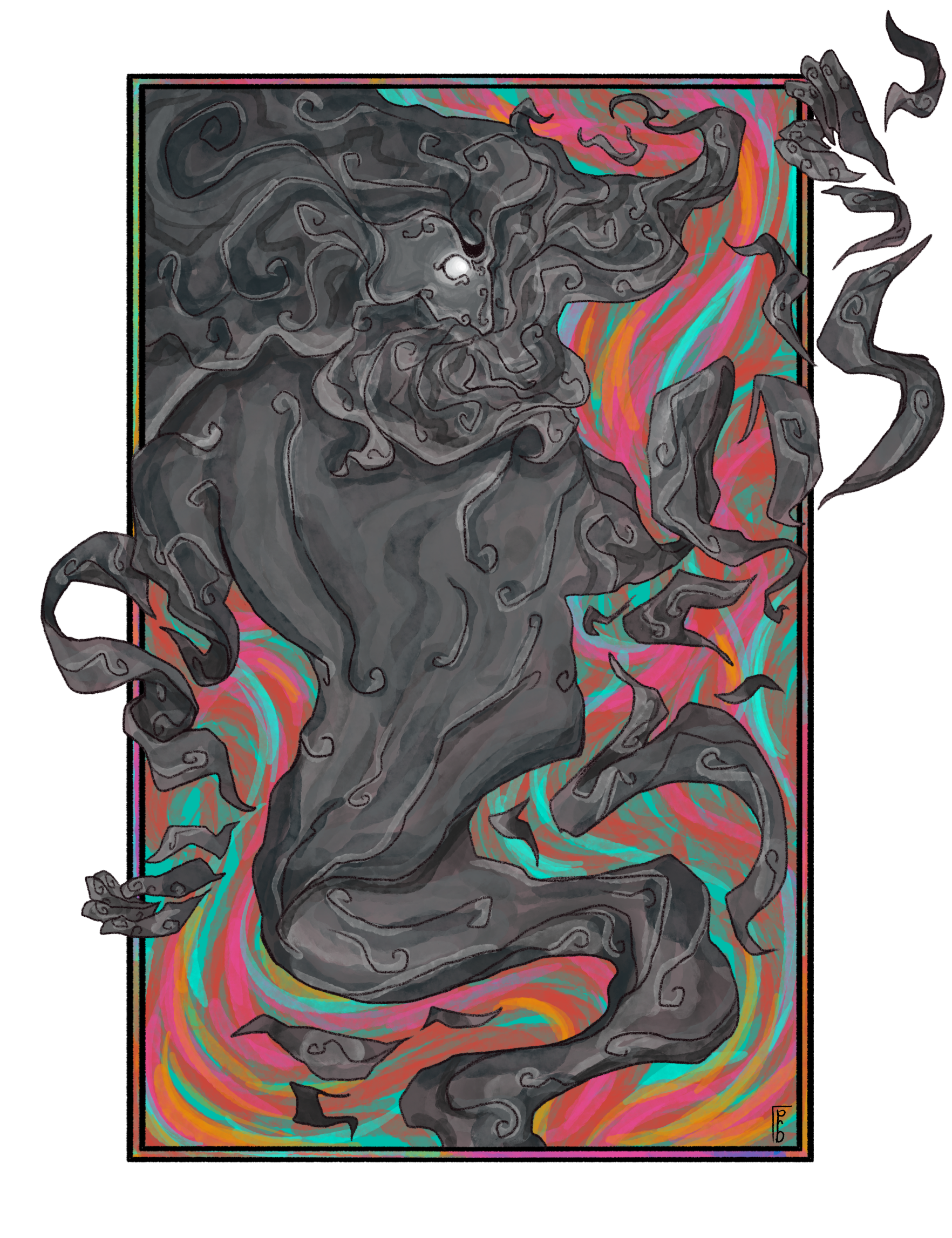 Olsevor, by Pro, 2025.
OLSEVOR. Maldeity The god of fury and the brewing tempest, one of the three God-Foes. He is the natural adversary of Caulrim, Gluthrim and Sholnim, and is often called the Trollraiser, for he begot the race of trolls. His work is to spur Men’s rage to its most perilous heights and to bring wild beasts and calamity upon them. Father of Felseva, Olsevor is responsible for the disordered, destructive elements of nature, hurling violent storms upon the lands and seas of Armenground. Sea serpents in the deep obey his bidding, and vile herbs, as gluskmoss, are of his creation.
Olsevor, by Pro, 2025.
OLSEVOR. Maldeity The god of fury and the brewing tempest, one of the three God-Foes. He is the natural adversary of Caulrim, Gluthrim and Sholnim, and is often called the Trollraiser, for he begot the race of trolls. His work is to spur Men’s rage to its most perilous heights and to bring wild beasts and calamity upon them. Father of Felseva, Olsevor is responsible for the disordered, destructive elements of nature, hurling violent storms upon the lands and seas of Armenground. Sea serpents in the deep obey his bidding, and vile herbs, as gluskmoss, are of his creation.
ORVO STAFFGRAVER. 1112–1326. Person A second-millennium scholar of the dwarrows. He was the first of the Staffgraver line, so named for their carving of runic staves, or letters. His early reckoning of dwarrow-kindred, and of the reigns of Kings Viling and Saardo, is considered authoritative.
OWIL. Deity Also the Timeless. The theorized progenitor of motion in the universe: a catalyst or god of gods. Hailing from a higher, incomprehensible plane, it is thought to have shattered the constant, unchanging, crystallized divinity of the universe into the current mangled, dynamic conflict of harmony and chaos. Depictions—and, in fact, positions on the very existence—of Owil vary from culture to culture and person to person. Less tangible than the gods and giddens, it is a subject of debate and extensive occult practices and rituals. Common renderings of Owil show it as a robed, faceless observer. It is titled a god of gods or god of time. Owil is theorized to be the source of galder—expendable divinity drawn from a plane beyond planes, as harnessed by Arkenwen.
Owil is, for all purposes, an in-universe reflection of the gamemaster or dungeonmaster, called the taleteller in the context of Armenground.
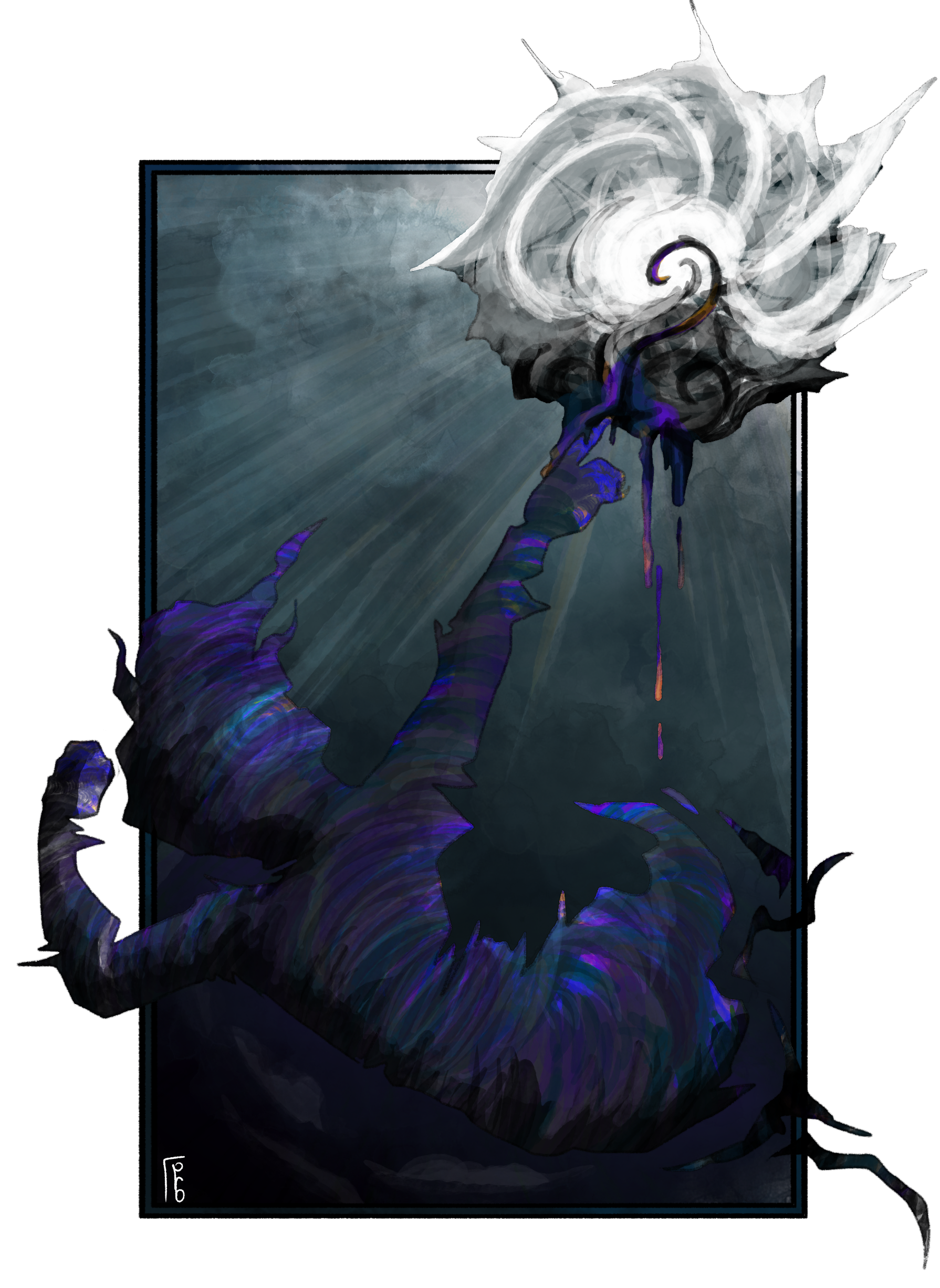 Paithar corrupts Stornelwen, by Pro, 2025.
PAITHAR. Maldeity Also the Great Shathe. The chiefest of the God-Foes and the most adept architect of discord throughout Armenground. The god of destruction and blight, he incited the first godslaught in the universe and is the most hated chaos-divinity by the Twelve. His greatest crime was in deceiving Stornelwen into distrusting and fearing his sister, whom he then betrayed to spread his silver light. The subsequent chaos resulted in Stornelwen’s sundering at the hands of Bleewen, his mother—the first killing of a god. Paithar has since busied himself perverting the cycle of life and death in Armenground, promoting undeath, spreading chaos, raising monsters and altogether afflicting creation with evil—in his view, advancing it toward beautiful, flattened entropy.
Paithar corrupts Stornelwen, by Pro, 2025.
PAITHAR. Maldeity Also the Great Shathe. The chiefest of the God-Foes and the most adept architect of discord throughout Armenground. The god of destruction and blight, he incited the first godslaught in the universe and is the most hated chaos-divinity by the Twelve. His greatest crime was in deceiving Stornelwen into distrusting and fearing his sister, whom he then betrayed to spread his silver light. The subsequent chaos resulted in Stornelwen’s sundering at the hands of Bleewen, his mother—the first killing of a god. Paithar has since busied himself perverting the cycle of life and death in Armenground, promoting undeath, spreading chaos, raising monsters and altogether afflicting creation with evil—in his view, advancing it toward beautiful, flattened entropy.
ROSGLAÑVIZ. Geography The greatest of the high-elven cities, set in the northeast of Armenground. Fixed along a wide, reflective river, it is a towering collection of sun-bleached limestone buildings built of stone quarried from the surrounding hills. Its relatively northern positioning leaves it in a state of near-constant twilight broken by short or long nights depending on the time of year. Within the terraced layout of Rosglañviz, each building and every open court is purposefully positioned to invite a play of light and shadow, accentuating the beauty intrinsic to elven design.
Though much of the city is supplied by the products of its own small gardens, the surrounding towns—Merdregad, Trezhelieg, and Landarzeg—underpin the city’s supply of raw materials. The politically organized territory of Rosglañviz and its surrounding towns is known to Man’s scholars as the Kuzulate, as it is ruled by an elder council known in Elvish as the kuzul.
SATWEL. Deity The gidden of song born to language-god Halwen and spring-gidden Selvenna. The only divinity that is a combination of two others, Satwel was not born with a set purpose but was instead the fruit of her parents’ love. After a difficult search for her own purpose, she eventually found her calling in her invention of music, which she gave to the races of the world. She finds companionship in the other creative and social gods, such as the kin of her father, and of craftsman-god Cland and trust-god Naoth. As gidden of song and music, her closest bond is to Simbelwin, god of revelry. She does not see music as trivially or merrily as Simbelwin, however; to her, music is a crack in reality through which the beauty of divinity may be more clearly experienced by mortals.
THE SCHOOL of LISSFALL. Building The foremost institution of higher education in the Kingdom of Honnerich. Located only yards from the Lisskeep and overlooking the rest of Lissfall, the School enjoys the patronage of the royal House of Furnelming and is the heir of the richest intellectual tradition of the Honeylander nations. The institution generally offers tutelage and academic apprenticeships in highly specific fields rather than formal classes, though classes in perennially demanded subjects—history, literature, and art—are taught by a small board of full-time scholars. Though it maintains a lineage of predecessors, the present School was founded by the law-scholar Swithon the Scribe in the year 6199.
SELTHWEN. Deity One of two deities (together with Arkenwen) to not have fallen neatly into the Twelve or the God-Foes. The god of luck and chance—considered by shrewd scholars to lord over physics itself—he is arbitrary and wanton in his deeds. Players of games of chance know him as the Coin-Turner; he is also the referent of the Honeylander expression “He palmeth thee not”, expressing that one’s luck has turned for the worse. As far as mortals can tell, Selthwen largely uses his power to satisfy his own fascinations rather than to influence the cosmic struggle, hence his lack of divine alignment. Societies have been known to use his image to indicate fortune’s favor; an image of a city or kingdom held in the palm of his hand carries strong meaning.
SELVENNA. Deity The gidden of spring and flowers, daughter of the glade-gidden Gelthiwil. It is said that in the beginning of the world she taught the birds to twitter and the flowers to open. She and her lover, language-god Halwen, brought forth Satwel, who came to invent song. With a deep preference for her aunt Tosnawil’s taste for prolific, genuine creation—rather than the more careful artisanry of Gelthiwil—she took on a form more closely resembling Tosnawil and shaped the meadowmen, inspired by Tosnawil’s creation of the ents. She is said to carry a cherry-wood lute strung with the naturally fallen hairs of a unicorn’s mane: a gift from her daughter, the gidden of music. So too is she legendarily told to bear a silver blade used only to cut flowers.
Reverence of Selvenna is unanimous among meadowmen and common among provincial folk of other races, who often create verdant shrines for her on windowsills. She is invoked to bring forth sunlight in the dreary days of winter, foretokening the coming spring.
SHOAKIL. Deity The god of blades, son of war-god Hardol. The apprentice of Cland, Shoakil fused his father’s martial inclinations with a talent and appreciation for physical craftsmanship. He sharpens and refines the blades of Cland and forges legendary weapons for the gods and, in extremely rare cases, worthy mortals. Often trapped in the depths of his own thoughts, however, he is prone to forging and re-forging blades obsessively, sometimes for decades or centuries. Shoakil commands a devoted following among bladesmiths and swordsmen; blades are often sharpened to prayers in Shoakil's name, or simply to the reduced adage “Shoakil whetteth what cutteth clean”.
SHOLNIM. Deity The god of the beaches, son of the sea-god Caulrim. He is portrayed as a sandy-haired, ocean-eyed young man clad in simple white garments. Tasked with slowing down the tempests of Gluthrim and Olsevor as they reach the shore, he has found fulfillment in the admiration of mortals. He happily plays into and enjoys the heroic image he has built, appearing to groups of humans at the seaside at a frequency higher than any other divinity. His fixation on his image has, however, led to disdain for his vanity by the other gods. Devotees etch intricate runes and patterns into the sands beaches to vie for his attention.
SIMBELWIN. Deity Also the Laughing Host and Found-in-Mirth. The god of feasting, son of harvest-god Grawmil. As Grawmil had never grown fond of celebrations of his work, he delegated harvest festivals and jubilation generally to a son. As the patron of revelry, he is characterized as a heartily laughing young man, caring for his guests and sharp in conversation. He shares a close bond with Satwel, gidden of song and music. Simbelwin is ascribed various qualities based on the culture of merriment held by the people at hand. Known as a natural entertainer, Simbelwin is often blamed for several phenomena: the warmth that comes from drinking alcohol; the inescapable urge to laugh at a dire situation; and jokes that fly off the tongue without a second thought.
Some agricultural villages maintain that there are two aspects of Simbelwin—‘the Laughing Host’ and ‘the Mourning Host’, the latter of which is shown during times of drought or famine. When this aspect shows itself, Simbelwin is characterised as a sober-faced young man; quiet and contemplative, he mourns the lack of his father's bounty. In this lens, Simbelwin thus becomes more of a god of community and empathy rather than one of simple mirth. This interpretation, however, is not universal.
THE SKYGORE. Item A spear of concentrated thunder and lightning shaped and wielded by the hands of Gluthrim. Nearly inseparable from his hand, it strikes with a thunderclap and charges its victim with an uncontainable burst of energy. The weapon was created by Gluthrim with the vision of him eventually confronting and killing Paithar face-to-face. The elusiveness of Paithar has precluded that possibility, and Skygore has only seen use in smiting a handful of lesser enemies of Gluthrim. A manifestation of deific rage, it is among the most powerful weapons in the universe.
SOLM. Deity The god of breath, respiration and renewal—the junction between living beings and the sky. The son of Feldenna, he is responsible for resurrecting those killed wrongly, but the taxing nature of resurrection and robbery of souls due to his brother Grimmil means that this is a rare deed. A close friend of glade-gidden Gelthiwil and tree-gidden Tosnawil, Solm can be seen fleetingly at the treelines of meadows. Otherwise, his visits to the mortal world are rare and, in the case of resurrections, critically exhausting. Devotees to Solm engage in wind-chorus ceremonies, using wind instruments to offer music to him. Skies and air are embodied in their prayers, and acts of breath control and singing are forms of highest worship. His unusually concise name is designed such that it may be spoken over the course of a single breath, made long and melodic in liturgy.
THE STAFF of DEATHLESS GREEN. Item The divine wand used by Tosnawil to animate the ents. A great gnarled staff ensnared in roots, vines, and leaves, it was a creation of her own divinity. Soon after the birth of the ents, Tosnawil passed ownership of the Staff to the Elder Grove, where it remains.
STENDEW. Deity The god of the moon, a humble fragment of the former silver sun-god Stornelwen. Shining far more meekly than his predecessor, he lives in constant shame for Stornelwen’s deeds, barely contributing a share of the lost light. A troubled figure not born naturally or truly purposefully, Stendew is aimless, inconsistent, and inglorious compared to his predecessor. He feels the moral weight of Stornelwen’s deeds, but is equipped to do little more than eternally repent for them. The cycles of the moon are popularly attributed to Stendew’s ashamed need to hide his face in his crushing guilt. Each lunar phase represents Stendew’s shifting emotions—from sorrow to acceptance—and the tides of the sea respond in kind, manifesting his influence upon the world. Devotees to Stendew take to confessing their shame under the soft glow of the moon. Stendew is also considered the patron of looking glasses, or mirrors, which represent the reflected light of the sun and the secondary nature of the moon. For that reason, he has been called the Mirror of Remorse in literature.
Heartfelt confessions spill forth more freely under Stendew’s moonglow, and the god’s followers truly believe that as they unburden their souls to the pale glimmer in the night sky, Stendew listens with profound sympathy, his light growing just faintly brighter with every careful release of mortal woes.
STILIWIN. Deity The gidden of rest and repose, the daughter of Feldenna. Characterized as speaking only in whispers, she drifts through the world, enriching rest for mortals. Characterizations of Stiliwin emphasize the golden light popularly associated with dreams inspired by her. She is closely bonded with prophecy-god Bilvendol, and the two have woven their crafts into the spinning of augural dreams in mortals. The most devoted communities to Stiliwin arrange a communal nap time—a stilltide—to bask in the blessing of rest. Shrines to her are constructed in ways which minimize distractions and disturbances.
STRANGIL. Deity The god of the far stars: the shattered remains of Stornelwen. Though with the largest domain, Strangil leads the quietest existence. Alone at the edge of the universe, he watches the movements of the God-Foes from afar, reporting on them to the Twelve as he can see them. Lording over stars too faint for humans to easily observe, Strangil has few interactions with mortals and has developed a distaste for them accordingly; to him, the mortal struggle as the center of attention is a narrow-minded one. He spends his days philosophizing, speaking pensively to the few gods that stray from the center of the universe. He can see Armenground in the distance and has idly poked holes through the world now known as glassgates.
Strangil is most often visited by Bleewen, who seems to view him, in his scatteredness, as a conduit for her guilt from the slaying of Stornelwen.
SUDARTHAGAYYAN. Person சுடர்தகையன். An ancient mytho-historical king of the Sunhursten, bearing sway over the Hursten Shore, called Thuraynádu, as a realm in full. He lived to great age as a prince dearly beloved by his people. He flung a bolt from a ballista through the neck of a fire-drake, and with his sabre of black steel he smote and hewed down ghouls by the dozen. Born to humble olive-tillers, Sudarthagayyan was heir neither to great substance nor to high degree. Yet he proved himself a valiant and well-advised warrior against the powers of chaos, and so grew into a conqueror whose acts were turned into tale and song. By the earnest love of his fellows and of the commons of the city of Waternake, where at the last he made his seat, he was crowned King of the Karayyinar, the Sunhursten. Howsoever his exploits seem heightened by later scholars, there is no doubt but that Sudarthagayyan was a true hero of notable pride and renown, who brought the scattered cities of the Shore into one fellowship for a rare age of concord. A standing image of Sudarthagayyan in the minds of his sea-bred countrymen is this: that he came sailing into the haven of Waternake, the head of a sea-serpent fastened upon the prow of his vessel, which is still a lively remembrance in the ancestral memory of his people.
SUNHURSTEN. Culture The native folk of the Hursten Shore, a people of the sea-coasts, for the most part raven-haired and of a middle to swart complexion. They speak diverse languages, including the regional common speech of Kilavic, and are born seafarers, devout in the worship of Caulrim, Sholnim, and Tosnawil, who in the Kilavic tongue are called Kadalvél (கடல்வேல்), Karayvél (கரைவேல்), and Cháyammal (சாயையம்மாள்). The Kilavic designation for the Sunhursten is Karayyinar.
TALTER the PROUD. Person One of the first two Men together with Wendelwen. His legendary vanity at the First Dawn is said to have driven the gods to curse Men with short lives. Talter was ultimately thrown from the Galderbarrow; he struck his head on the now-fossilized Tree of Pride when tumbling down the mountain face and died thereat.
The other of the first two Men, Wendelwen, bore triplets after pleading with the gods for a chance at redemption. Wendelwen and the children were judged to have outweighed Talter’s vices with good, and the gods seeded the world with sundry kinds of Men accordingly. Talter’s has since become a cautionary tale emphasizing humility, and his death has been reused as a literary trope in several epics, as occurs in the story of Hollward. His role as the vain half of a duo has also invited comparisons to Stornelwen, and Talter has thus been occasionally called “the Silver Sun of Man” in literature.
THIRUMÁYICHITAY. Geography Thirumáyi’s-pyre. A mountain town of the Hursten Shore perched along sloping terraced farms of tea and cardamom. It was built in the place of an earlier settlement, Mégamalay, after its headwoman burned that town from within as a final defense against dark encroachments millennia ago.
THURSE. Race Any of the thurses, or “fen-devils”: a wise race of bark-skinned, centaur-shapen bog-creatures, well practiced in enchantment. They see Men as cute and endearing, and oft keep them as household pets; yet their monstrous bulk and low, rumbling tongue, scarcely known to the mind of Man, make parley challenging.
TINKERER. Playable Class Also artificer. Finding a middle ground between invention and galder, tinkerers are known to innovate ways of fighting, enchanting, and defending. Upon reaching the third chamber of might, a tinkerer may begin to take on a professional specialty.
TIRAWEN. Deity The gidden of winter, daughter of mountain-god Blondorim. Violent and tempestuous—but contemptful toward the God-Foes most of all—the periods of her emergence into the world are times of great beauty but simultaneous hardship. Though she favors the ice elves, she is unmoved by the causes of most mortals and generally strikes all with equal coldness. To Tirawen, testing the resolve of mortals with the cruelty of winter is a source of fascination. Devotees to Tirawen embrace the season’s cruelties and partake in extreme winter rituals like taking icy plunges in the frozen lakes and performing lengthy dances under the snowfall to show their dedication, hoping that attunement to her will prevent her harshest caprices from afflicting them at the wrong time.
Honeylanders celebrate Tirawentide, a mid-winter festival of prayer to Tirawen. The air is said to warm slightly during this period, though it is uncertain whether the phenomenon is a rare mercy from Tirawen or merely the impression gained by drink-heated revelers.
TOSNAWIL. Deity The gidden of trees and of the greater growths of the earth, and one of the Three Siblings, those three deities to whom the governance of the soil is committed. Being much given to sudden fantasies, she, with the Staff of Deathless Green, did quicken the ents unto life, to be her fellows in solitude; she is hence called the Entmother in many writings, and is called the patroness of the tree-elves. She was humbled, however, at the First Dawn, when the other gods chastised her for the frivolity of her works and charged with ents in aiding her in the husbandry and keeping of the earth. She thus left the Staff in the keeping of the first ents of the Elder Grove. Nevertheless she was not left friendless, for her niece Selvenna, taking a shape more like unto hers, upheld her plenteous and unfeigned love of creation.
THE TREE of PRIDE. Geography A warped, partially fossilized tree on the south-central slope of the Galderbarrow. It was the death-place of Talter the Proud, who, when thrown from the peak of the mountain at the First Dawn, struck the tree and perished. Its dry bark and bizarre shape is evidence of the events of the First Dawn, though small green leaves grace it still. Some theorize that the Tree was the final destination of Wendelwen’s death-pilgrimage to the Galderbarrow.
THE TWELVE. Word A popular and prevalent theological label for the twelve elder gods—that is, gods with clearly manifest offspring—who avouch and uphold conscious creation. Against them stand the God-Foes. Two gods, Arkenwen and Selthwen, are held of many to fall into neither company, and are diversely disputed among theologians.
VATARAM. Geography Red-date-tree. A fishing village south of Ehmárávinkuda, itself south of Waternake. A red date orchard overlooks the town and is the evident source of its name. It was known in past ages as Vátanaram, of which Vataram is perhaps a folk reinterpretation.
VELWEN. Deity The gidden of the sun. Velwen is the only survivor of the twin offspring of light-gidden Bleewen. Bleewen imbued Stornelwen with silver light and Velwen with golden light, setting them over the world as twin suns. After the slaying of Stornelwen, Velwen remains the sole sun over Armenground. Deceived by Paithar into believing that Velwen wished to outshine him, Stornelwen cast an silver sheet over Velwen to allow his light to shine farther. Fearing the worst, Bleewen struck him down with her rainbow-hued sword, carving Stornelwen into Stendew, the moon, Stornawil, the near stars, and Strangil, the far stars. Velwen has since clad herself in golden armor in fear.
Though wronged by Stornelwen and Paithar, Velwen still bears considerable guilt and anger with her following the sundering. Sunburns are popularly attributed to her simmering frustration with the death of her twin; others say that she must burn brighter to make up for the loss of Stornelwen, thus causing the burns. Despite her considerable domain, Velwen is scarcely worshipped in Armenground and is considered exceptional, particularly among Men; Bleewen is largely thanked for the light she emits. In Elvenlands, however, more attention has been paid to Velwen.
VENDRA. Maldeity The gidden of corruption and greed, known for leading mortals astray in their motives. She maintains a fierce and primordial rivalry with Naoth, god of trust and companionship. Vendra is known to tempt the souls of godswysards upon their deaths, coming to them before Grimmil’s arrival and promising them immortality in their moment of greatest vulnerability. Those who accept her offer are cruelly warped into wraiths—restless, wandering malevolent spirit-sorcerers. More generally, Vendra is involved with whittling away at the virtue of mortals. Those who entirely forsake harmony under this pressure are condemned to become ghouls.
VENSITH. Maldeity The god of fear and desperation, the son of corruption-god Vendra. He is known to push wysards by nightmares and visions to fear their mortality, guiding them toward the art of lichwielding: necromancy. Seekers of Vensith’s power often swear themselves to him, a dark and dangerous path in the service of chaos. Though his followers are often shunned and reviled by society, a small and devoted following still clings to him, believing that his powers can keep them from fear. Vensith is a comparatively young god; he was was born after the death of Nithrend as an answer to the valor of early mortals.
WARLOCK. Playable Class A calling in Armenground. To achieve a powerful command of galder, warlocks are bound by pacts to otherworldly entities. To enter the first chamber of might, a warlock must seal a pact with a supernatural power.
WATERNAKE. Geography The most peopled city-state of the Hursten Shore, home to six hundred and thirty-three thousand souls. In Kilavic, the local language, it is known as Verunír. Founded in antiquity, it has passed through many courses of rise and ruin, but has prospered in recent centuries. It abounds with many wares of surpassing worth, being the greatest port on the southeastern shores of the known continent. Much merchandise from the Far South is brought into its wide harbor, and therefrom it sends forth more exports than any other place upon on the Shore. Its shipbuilders are the most skillful and renowned in the known world, and the guilds of that craft wield powerful influence within the city; the various merchant guilds choose a governing suzerain, who is now the shipbuilder Kadalnéyan.
WENDELWEN. Person Also the Begger of Life. One of the first two Men together with Talter. After Talter was cast from the Galderbarrow by the gods for his insolence, Wendelwen pleaded the case of Man and asked to bear triplets in proof of the goodness of the race. She and her three children—Delwenin, Morwendel, and Wendelthrim—worked in concert to prove the worthiness of Man before the gods. She resided in Lissfall with her grandson Furnelm until, after 104 years, she undertook a journey to return to the Galderbarrow—possibly to the Tree of Pride—and was not seen again. Her descendants have since formed the first of the Honeylanders’ athel bloodlines, though they have been joined by other great deed-doers of history.
WELVAN of AYLFIELD. 5365–5459. Person A sixth-millenium Honeylander scholar and philosopher. His chief labor, and his only full work that has escaped the spoilage of time, is entitled A Chronicling of the Heretofore-known Histories of the Great Nations of Man. It has since more often been called The Chronicle of Welvan. Composed at Lissfall, the Chronicle endeavors to chart all of mortal history with respect to the Honeylander nations, whereof Welvan himself was born. His style of prose, together with the portraitures of his making, were greatly commended by readers and writers alike, and the book remains a principal and much-noted authority for the first ages of Honnerich, Morrethel, and Suthrim.
WHERE SNARLS the DARKNESS. Campaign The first campaign to be held in Armenground, tracing the deeds of three wayfarers in their struggle against evil after escape from enslavement by lichwielders. Held in an early form of the world, it is now semi-canon. Full page here.
WILDLING. Playable Class A calling in Armenground. Both feared and respected, wildlings are warriors whose triumphant performance in combat is ultimately drawn from unbridled rage, itself enhanced in a variety of ways. Consciously or unconsciously, they channel the thunder of Gluthrim and the fury of Olsevor in their wrath. Upon reaching the third chamber of might, a wildling may begin to follow a specialized path.
WISWENDEL. 28–201. Person Also the Wytchmartyr. A galderborn sorceress of the first and second centuries. Twin to Nithrend the Greedwysard, she was granted deathlessness by Grimmil until she could bring her lichwielding brother to justice. She was ultimately captured and sacrificed by Nithrend at the Dire Dais in the year 201, precipitating the great war against him and Nithrend’s death at the hands of a united mortal army. Wiswendel’s son, Wisgon, lived beyond Wiswendel and Nithrend, championing galder for harmonic good and further pioneering its use among the galderborn.
WRAITH. Creature The warped, undead spirit of a godswysard who bent to the will of Vendra. Vendra, gidden of corruption, tempts godswysards at their moment of death with immortality—should they accept in that most vulnerable moment, they are cruelly transformed into a vengeful, galder-wielding spirit of evil.
WYSARD. Playable Class Also galderlock. A caster of galder. In contrast to galderborn, who are innately imbued with galder, wysards devote themselves to learning and mastering it of their own accord. The art was pioneered by the first-century wytch Morwendel, Lady of Magick. Upon reaching the second chamber of might, a wysard espouses an arcane tradition.
WYTCH. Word Designation for a specifically feminine wysard, i.e. a witch. Sometimes also used of feminine galderborn.